
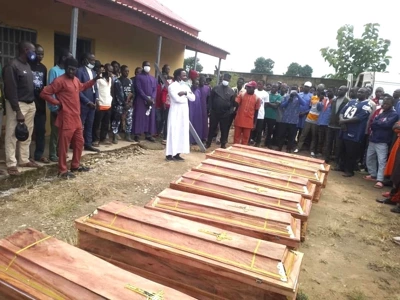
Funeral of Christians killed on Aug. 28, 2025, in Kauru County, Kaduna state, Nigeria. | Iliya Tata for Christian Daily International-Morning Star News
Bishop Murray, as you help the world listen to the tears and hymns of Nigeria’s saints, those echoes carry across a whole continent. The cries from Kauru County and Plateau State are not isolated; they reverberate from West Africa to the eastern shores of the Indian Ocean, where other children wake to gunfire, hunger, and betrayal in the name of Christ.
From Burkina Faso to Mozambique, Sudan to Congo, armed groups and Islamist extremists have burned churches, abducted believers, and devastated communities, leaving bishops and pastors pleading for their people’s lives. In Nigeria alone, thousands of Christians have been killed in recent years, in a “toxic cocktail” of terrorism, ethnic conflict, corruption, and state weakness, even as stories like little Ruth’s remind us that the Church, astonishingly, still sings.
But there is another sound under these echoes; the sound of judgment beginning “with the household of God” (1 Pet 4:17).
1. When the wound is internal: Shakahola and the apostate altar
In East Africa, the massacre has not only come from outside the Church; it has erupted from within its professing ranks. In Kenya’s Shakahola forest, more than 450 people, many of them children, died in a starvation cult led by a self-styled “pastor,” Paul Nthenge Mackenzie, who urged his followers to fast to death “to meet Jesus.” The dead were not killed by jihadists, but by a man claiming to shepherd God’s flock. https://www.bbc.com/news/world-africa-65374093
Shakahola has rightly been called one of the worst security and moral breaches in Kenya’s history, prompting calls for tighter regulation of churches and exposing how religious language can be weaponized to manipulate, control, and destroy. At the same time, Kenya sits just outside Open Doors’ top 50 World Watch List; ranked 51st, with believers still vulnerable to al-Shabaab attacks and communal violence, especially in coastal and northeastern regions.
So Africa’s wound is double:
• From without: militias, terrorists, and bandits targeting or engulfing Christian communities in Nigeria, Burkina Faso, Congo, Mozambique, and beyond.
• From within: false shepherds, prosperity “apostles,” ethnicized pulpits, and cult leaders like Mackenzie who turn the gospel of the Cross into an instrument of death.
This is what makes our cry uniquely African, and heartbreakingly biblical. We are facing both Saul’s spear and Judas’ kiss.
2. The church in the bosom of political barons
Across many African nations, politicians have discovered that the quickest road to legitimacy is through the sanctuary. They arrive with motorcades, sit in seats of honor, and “sow seeds” into the church projects with money often drawn from corruption, state capture, or ethnic patronage. In return, pulpits are muted, hands are oiled, and the prophetic voice is reduced to campaign slogans.
Like Israel’s kings who hired court prophets to bless their wars (1 Kings 22), many leaders now seek clergy who will anoint their ambitions. Some churches, drunk on prosperity promises and personality cults, have welcomed them. Instead of standing like John the Baptist before Herod, we flirt with Herod for a new church bus.
Meanwhile, when states turn their guns or neglect on their own citizens, in police brutality, electoral violence, or policy-induced hunger, the Church in many quarters has whispered instead of thundered. The blood of the poor cries out from the soil, but too often the microphones are reserved for those who pay the most.
This is apostasy in a suit and collar:
• When we bless stolen wealth while widows starve,
• When we trade the Beatitudes for branded conferences,
• When we preach “breakthrough” but not “repent, for the kingdom of heaven is at hand.”
3. A “Fullness of Time” moment for Africa (Galatians 4:4)
Yet even in this crisis, I hear another echo; the echo of kairos, of God’s appointed time.
“But when the fullness of the time had come, God sent forth His Son…” (Gal 4:4, NKJV)
In another dark hour of imperial oppression and religious compromise, God sent, not an empire, not a program, but a Person, the crucified and risen Lord. I believe we are again in a Galatians 4:4 moment for the African Church:
• The massacres from without are exposing the reality of spiritual warfare and calling us back to the Cross, not to comfort theology.
• The massacres from within, Shakahola and other abuses, are exposing our idolatry, our misplaced trust in “men of God,” and our failure to test spirits and structures (1 John 4:1).
No weapon formed against Christ’s body will ultimately prosper (Isa 54:17), but many weapons are being forged within our walls. Therefore the Lord is purifying His bride, burning away straw and stubble (1 Cor 3:12–15), shaking what can be shaken so that what cannot be shaken may remain (Heb 12:26–29).
From Lagos to Nairobi, from the Indian Ocean to the Atlantic, the Spirit is calling for a new African song; not just a song of survival, but a song of holiness:
• Holiness in doctrine: the gospel of Christ crucified, not the gospel of cash.
• Holiness in power: Spirit power for witness, not for show (Acts 1:8).
• Holiness in public life: churches that refuse to be chaplains of corrupt regimes, choosing instead to be prophets of the kingdom.
4. Learning again from Acts: prophetic patterns for a persecuted Church
The Book of Acts is not a romantic story; it is the diary of a Church under pressure, external and internal. It gives us a prophetic roadmap:
i. They returned to the Cross and to repentance.
At Pentecost, the first response to Peter’s sermon was, “What shall we do?” (Acts 2:37). The answer was not, “Give an offering,” but “Repent… and be baptized… and you shall receive the gift of the Holy Spirit” (Acts 2:38). Judgment first cleansed the Church itself; Ananias and Sapphira’s death exposed financial hypocrisy inside the community (Acts 5:1–11).
ii. They refused gag orders.
When the authorities commanded Peter and John not to speak in Jesus’ name, the apostles replied, “We cannot but speak the things which we have seen and heard” (Acts 4:20). Under threats, they did not seek palace patronage; they sought greater boldness in prayer and were filled again with the Holy Spirit (Acts 4:23–31).
iii. They reformed their structures to protect the vulnerable.
When Greek-speaking widows were neglected in the daily distribution, the apostles did not say, “That’s just how things are.” They restructured ministry, appointing Spirit-filled deacons and ensuring justice inside the Church (Acts 6:1–7). That is a model for addressing abuse, cultic manipulation, and financial exploitation in our contexts.
iv. They embraced persecution as a scattering for mission.
After Stephen’s martyrdom, the Church was scattered, but “those who were scattered went everywhere preaching the word” (Acts 8:1–4). Persecution became dispersion, and dispersion became mission.
v. They crossed ethnic, cultural, and political boundaries.
From Antioch, a multiethnic church fasted, prayed, and sent Barnabas and Saul to the nations (Acts 13:1–3). They refused to let ethnic identity or imperial borders define the reach of the gospel.
For Africa today, this means:
• Repentance and reform inside the Church,
• Courage and clarity in the public square,
• Intentional structures that protect the poor, women, and children,
• Embracing dispersion as a missional opportunity.
5. Echoes in the diaspora: songs by the rivers of Babylon
The tears of Africa do not stop at our borders. They flow through our dispersed sons and daughters, from London to Dallas, from Toronto to Berlin. The pain of massacres and corruption at home mingles with the wound of racialized suspicion, economic exploitation, and cultural dislocation abroad.
We are like the exiles in Psalm 137, who hung their harps by the rivers of Babylon and asked, “How shall we sing the Lord’s song in a foreign land?” The tension remains:
• To settle, build houses, seek the peace of the city (Jer 29:4–7),
• Yet to remain restless, like Nehemiah, whose heart could not rest while Jerusalem’s walls lay in ruins (Neh 1–2).
The African diaspora Church must not become a comfortable museum of nostalgia. This dispersion is itself part of God’s fullness-of-time strategy:
• We know the taste of persecution and the smell of mass graves.
• We understand the language of poverty and political betrayal.
• We carry inside us both the lament of Psalm 137 and the commission of Acts 1:8.
Therefore, in the West, the African Church must:
1. Watch against complacency.
Refuse to be seduced by consumer Christianity. Keep the memory of suffering saints alive. Tell the stories of Nigeria, Burkina Faso, Kenya, and beyond in our sermons, prayer meetings, and discipleship.
2. Educate and empower.
Teach our children and host churches about the persecuted Church, global injustice, and kingdom ethics. Use our experience of marginalization to advocate for justice, locally and globally, without bitterness but with prophetic love (Heb 13:3).
3. Stand and shine.
Plant Christ-centered, holiness-seeking communities that model racial reconciliation, integrity, and generosity. Refuse ethnic tribalism in the diaspora; instead, embody the multiethnic Antioch church that listened to the Spirit and sent missionaries back into the world (Acts 13:1–3).
4. Carry Nehemiah’s burden.
Let our prosperity never anesthetize our concern for the continent. Like Nehemiah, we weep, fast, pray, agonize and organize, even from a foreign court, until the gates are rebuilt and the people’s dignity restored (Neh 1–2).
6. A prophetic appeal: from massacre to melody
So, Bishop, as Nigeria’s Church still sings through tears, I add my voice as a son of Africa:
• We confess our complicity where we have sold our birthright for political favor and prosperity promises.
• We grieve with those whose blood cries from both the villages attacked by militants and the shallow graves of Shakahola.
• We believe that “in the fullness of time” God is exposing, cleansing, and re-consecrating His Church in Africa.
May a new song rise:
A song of holiness, of costly discipleship, of courage before kings, of compassion for the wounded, of steadfast hope in the Crucified and Risen One.
The massacres are indeed from within and without, but so is the purification. The same Spirit who strengthens Nigerian believers to sing amidst ashes is calling the whole African Church, on the continent and in the diaspora, to repent, to rise, and to re-sing the gospel with clean hands and pure hearts.
Until then, we will not hang up our instruments forever. We will tune them with tears, lift them with trembling hands, and sing, not for empire, not for politicians, not for prosperity, but for Jesus Christ, the Lamb who was slain, who alone is worthy of Africa’s ultimate song, the song of The Lamb “…IN THE FULNESS OF TIME!